Bob Dylan’s biography begins with a boy from Duluth, Minnesota, who became one of the greatest songwriters of the 20th century. He wrote hundreds of songs that cover a range of styles from folk to rock to standards that stand the test of time, to works that garnered him the Nobel Prize in Literature.
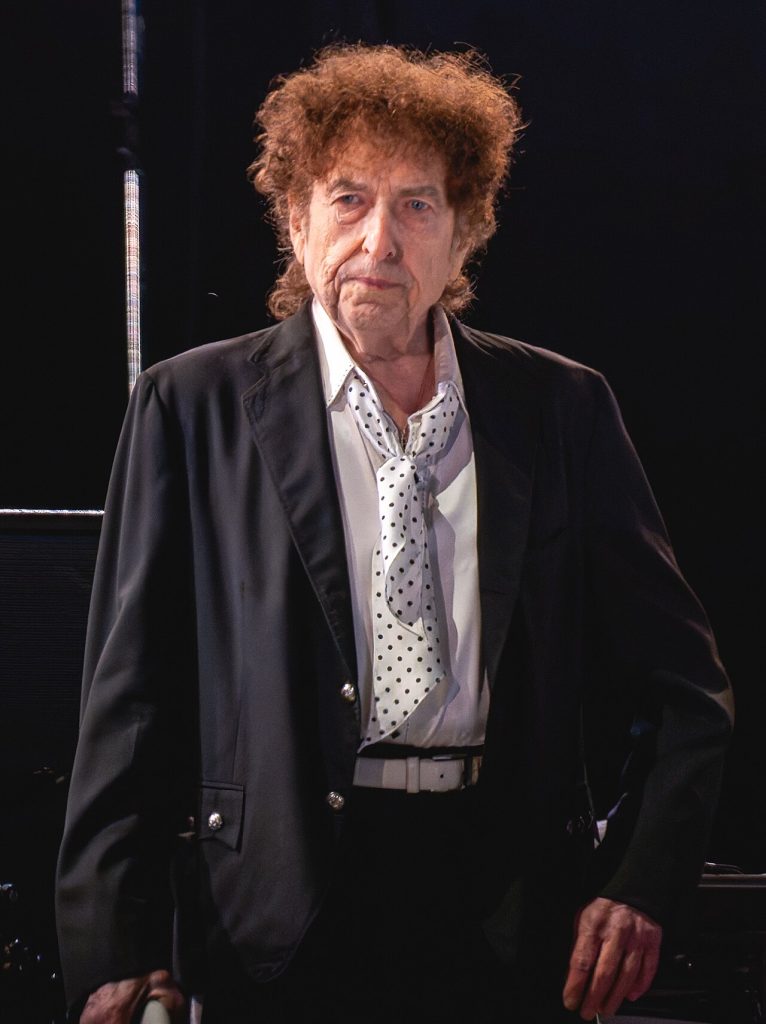
Quick Facts
| Fact | Detail |
|---|---|
| Birth name | Robert Allen Zimmerman |
| Born | May 24, 1941 |
| Birthplace | Duluth, Minnesota, USA |
| Genres | Folk, rock, country, gospel |
| Occupations | Singer‑songwriter, musician, author, actor |
| Years active | 1961–present |
| Labels | Columbia Records |
| Major awards | Nobel Prize in Literature (2016), Pulitzer Prize special citation (2008), 10 Grammy Awards, Academy Award, Kennedy Center Honors (1997), Presidential Medal of Freedom (2012) |
| Hall of Fame | Rock and Roll Hall of Fame, Songwriters Hall of Fame |
| Record sales | Estimated 125 million worldwide |
Early Life and Background
Dylan entered the world as Robert Allen Zimmerman at St. Mary’s Hospital in Duluth, Minnesota on May 24, 1941. His paternal grandparents escaped the 1905 pogroms that ravaged Odessa. His maternal grandparents crossed the Atlantic from Lithuania in 1902. Dylan’s father contracted Polio when Dylan was six years old. The family then moved to the Mining town of Hibbing.
Dylan attended Hibbing High School. There, he formed a band, The Golden Chords. The band drew influence from artists such as Little Richard, and Elvis Presley. In 1959, Dylan’s band, The Golden Chords, covered “Rock and Roll is Here to Stay”. A performance that Dylan recalled having the best time at. The microphone gave out during the performance. In 1959, Dylan attended a performance by Buddy Holly at the Duluth Armory. That evening inspired Dylan to set a new standard for himself when writing songs. Dylan attended the University of Minnesota for a brief period, but left to pursue a career in music.
Upon graduation, Dylan attended University of Minnesota in September 1959. In the meantime, he honed his craft at the Ten O’Clock Scholar, a coffeehouse where he moved away from rock and onto folk with the discovery of the richness of traditional songs. It was there that he performed for the first time as “Bob Dylan,” as a homage to Dylan Thomas for his poetic edge and literature background.
The influence of American roots is heard throughout his early work. He listened to and learned from Woody Guthrie and Robert Johnson, and was a huge fan of Hank Williams and the metal guitar picker Merle Travis. He read classics like Herman Melville’s Moby Dick, All Quiet on the Western Front, and the Odyssey. Those literary and musical influences embraced and encouraged his own song writing. The historical and literary allusions in his songs reflected his burgeoning interest in literature.
Career and Rise to Fame
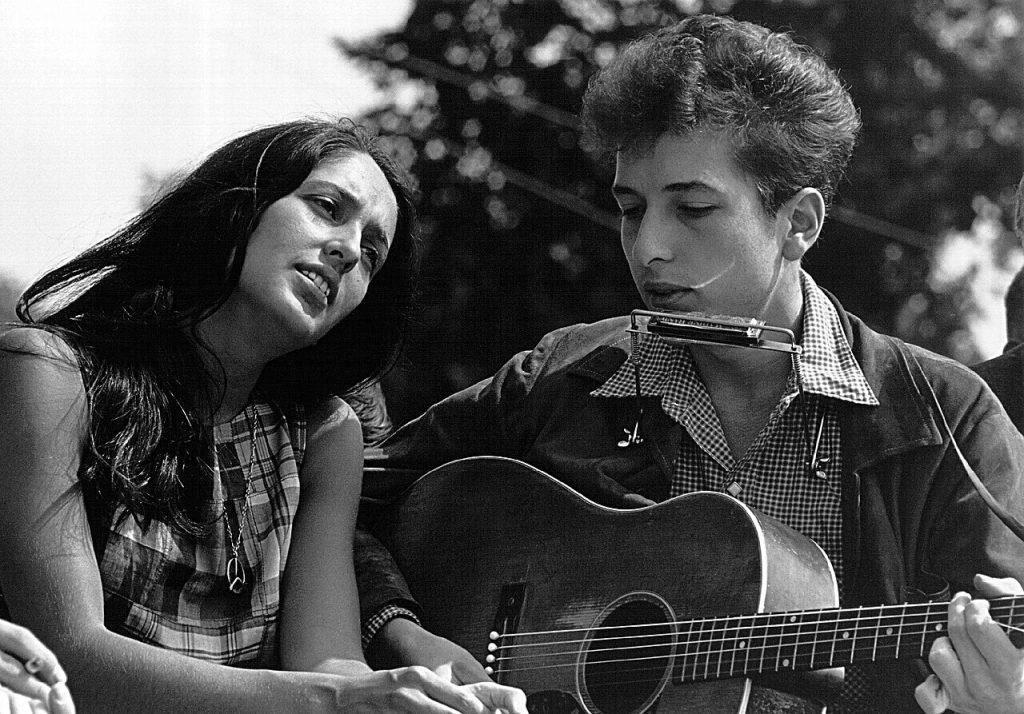
Dylan dropped out of college in 1960, and by 1961, was on a bus to New York City. While on his way to New York, he stopped to visit Woody Guthrie in a New Jersey psychiatric hospital. Once in New York, he performed at some of the Greenwich Village clubs including Gerde’s Folk City, where in September 1961, he got a rave review from Robert Shelton.
In 1962, Dylan released his first self‑titled album, which combined traditional folk songs with two of his own, “Talkin’ New York” and “Song to Woody.” It wasn’t until the release of The Freewheelin’ Bob Dylan in 1963, that he started to garner mainstream attention, selling around 5,000 copies and featuring the songs “Blowin’ in the Wind” and “A Hard Rain’s a‑Gonna Fall.”
He legally changed his name to Robert Dylan in 1962, in a St. Louis County Court with his father as the witness. In the same year, he signed a management deal with Albert Grossman.
Dylan shocked the folk establishment in 1965, when he released Bringing It All Back Home and Highway 61 Revisited, albums that featured an electric sound and breaking the sonic boundaries of modern pop music. “Like A Rolling Stone” also broke musical barriers and gave him international acclaim.
A motorcycle accident in 1966 caused a seven-year break from performing. It inspired a profound period of recording with the Band. This work was not released until 1975 and was known as The Basement Tapes. During this time he recorded his albums, John Wesley Harding and Nashville Skyline, which were country albums, and New Morning, which was a rock album.
1973 brought an acting credit in a Sam Peckinpah film, Pat Garrett and Billy the Kid, as well as a soundtrack, which included the film’s most memorable song, “Knockin’ on Heaven’s Door.”
Blood on the Tracks in 1975 became another critical success, which showcased the legendary song, “Tangled Up in Blue.”
The late 1970s brought a public conversion to evangelical Christianity, which inspired gospel albums, starting with 1979’s Slow Train Coming. His late period was marked by commercial downturns and critical comebacks. 1997’s Time Out of Mind, showed that he was timely once again, and provided his first album of the period to rise to popularity.
The late 1980s showed Dylan embarking on his “Never Ending Tour,” and in 2004, his memoir, Chronicles: Volume One. No Direction Home (2005), and A Complete Unknown (2024), presented a documentary and biopic on Dylan’s life and times.
Songwriting Style and Literary Influences
Dylan is perhaps the greatest songwriter of all time. He masterfully married the folk music tradition with the ideas of poets and writers. He drew early influence from Moby-Dick, the Odyssey and Arthur Rimbaud. Along with writing songs, he drew imagist poetry and wrote very abstract poems with shifting perspectives. Many of his poems were published posthumously by his wife.
Dylan used his art to denounce societal injustices. Songs like “Blowin’ in the Wind” became anthems of the counterculture movement, while “The Times They Are a‑Changin’” captured the mood of the restless 1960s. Towards the end of the decade, he began to sing more about his personal life, as heard on Highway 61 Revisited.
In the 1970s, Dylan’s music became more country-rock oriented, while his lyrics delved into personal territory, such as his born again Christian experience on the albums Slow Train Coming and Saved. He recorded gospel albums in the early 80s and then focused on more sci-fi inspired songs on Infidels and Empire Burlesque. His live performances during this time reflected his belief that songs were organic and could be changed and altered to fit the spirit of the times.
Electric Transition and Public Reaction
Multiple sources call Dylan’s 1965 Newport performance pivotal. Folk purists still maintain Dylan committed musical blasphemy when he plugged in and backed his band with rock musicians. As his song progressed and the rock band became more prominent, the crowd began to boo, protest, and throw things. Some reporters covered the event and captured the reaction, both good and bad, but the negative attention brought Dylan’s new single “Like a Rolling Stone” to the top of the charts, and introduced him to the masses.
Dylan’s electric shift shook the Folk world, opening doors to musicians like The Byrds and Simon & Garfunkel, which ushered the emerging genre of folk-rock. Even if he alienated many of his purist folk fans, Dylan’s shift opened up musicians to extending genre borders and thriving in the commercial space.
Later Career and Continued Innovation
After the gospel period, Dylan continued to experiment. The 1990s saw him collaborate with contemporary producers, including Daniel Lanois, and he recorded Time Out of Mind. This album and its production, featuring weathered vocal deliveries with reverb, textures and scatterings of the David Lynchian like abrasive sounds of the city, was a critical and commercial success.
In the 2000s Dylan released albums that sampled and covered his back catalog. His 2006 and 2009 albums, Modern Times and Together Through Life, respectively, put his lyrical crypticism with the blues. The music industry and the way people consumed music changed with the advent of streaming, and Dylan continued his “Never Ending Tour”. The long tours helped foster his reputation of having great live shows and rewarded fans with live performances of deep catalog and new songs.
Dylan is a painter and visual artist as well, and his works, like his songs, have been exhibited all over the world. His painting, like his music, is improvisational. His raw expressions have been exhibited in galleries and publishers, in forms of drawings, watercolors, and poetry throughout his career. The ten books of paintings and drawings released from the 1990s to 2010s, show Dylan’s musical improvisations.
Notable Works
Dylan’s discography spans more than thirty studio albums. Highlights include:
- The Freewheelin’ Bob Dylan (1963) – introduced protest standards and established his voice as a folk poet.
- Bringing It All Back Home (1965) – half acoustic, half electric, signaling his genre crossover.
- Highway 61 Revisited (1965) – featured “Like a Rolling Stone” and cemented his electric identity.
- Blonde on Blonde (1966) – double‑album praised for lyrical depth and studio experimentation.
- John Wesley Harding (1967) – marked a turn toward folk‑rock storytelling with biblical overtones.
- Nashville Skyline (1969) – country‑styled duet with Johnny Cash and a softer vocal approach.
- Blood on the Tracks (1975) – emotional narratives that revived his critical standing, featuring “Tangled Up in Blue”.
- Slow Train Coming (1979) – gospel‑infused record reflecting his Christian conversion.
- Time Out of Mind (1997) – Grammy‑winning reflection on aging and memory.
- Modern Times (2006) – blended blues and folk, earning a Grammy for Best Contemporary Folk Album.
Film contributions include acting in Pat Garrett and Billy the Kid and providing its soundtrack, most famously “Knockin’ on Heaven’s Door,” a song that has been covered by countless artists and used in film and television.
His written works extend beyond lyrics. The memoir Chronicles: Volume One (2004) offers a candid look at his early years, while his series of art books show his visual experiments.
Why Bob Dylan Is Trending Right Now
Recent news items show Dylan’s enduring cultural relevance. Pope Leo XIII receiving Dylan at the Vatican, mentioned in reports by Vatican News and Religion News Service, demonstrates the respect Dylan commands globally, well beyond the music world.
Elsewhere, Glide Magazine and Hotpress covered the recently released “Rolling Thunder Revue: The 1975 Live Recordings” box set and reflected on Dylan’s 1975-76 tours. The box set is said to include 371 previously unreleased songs, alternate takes, backstage discussions and live performances, and offers insight to scholars and fans on Dylan’s creative process.
CultureSonar mentioned a sold-out Dylan concert at Carnegie Hall and cited his deep catalog as evidence of his ability to reimagine his classics. CULT FOLLOWING raved about Dylan’s recent concert at Lotto Arena in Antwerp, praising the integration of new songs, and his ability to engage the audience with his most famous songs.
American Songwriter identified four overlooked songs on less famous albums, and encouraged listeners to explore the hidden gems in Dylan’s catalog. Ultimate Guitar reflected on Dylan’s electric debut, and noted that after just three songs at the 1965 Newport Folk Festival, Dylan walked off stage, igniting a debate that rages on to this day.
Britannica published an exploration of the lyricism and composition of “Blowin’ in the Wind,” and its enduring status as a protest anthem. Other reports recognize Dylan’s status as a touchstone for all serious music critics, scholars and fans.
Personal Life
Dylan’s ancestors are from Jewish immigrant backgrounds. His paternal grandparents were from Odessa, and his maternal grandparents were from Lithuania. Moving to Hibbing, put him in a close-knit community where his father recovered from Polio, and opened a furniture and appliance store.
In the 70s he made a public conversion to Christianity and created a series of gospel-centered albums, starting with Slow Train Coming. He continued to include spiritual themes in his music and blend biblical references with his thoughts and feelings.
He has lived in many different U.S. cities. New York during his Greenwich Village days, and later Woodstock, New York where he has a private residence. He rarely gives interviews, but has shared his thoughts on art and said his name change was for self definition.
He has a raw and expressionist style when it comes to the visual arts. Dylan has also published a memoir, where he talks about his early career and art, and shares his thoughts on society and himself.
Awards and Recognition
Dylan’s accolades are many. He won the Academy Award for Best Original Song for “Things Have Changed” in 2000, which also honors his ability to pen songs for the screen. Dylan won ten Grammys for various categories from folk to rock. He won the 1997 Album of the Year Grammy for Time Out of Mind. The 2008 Pulitzer Prize special citation honored his “profound impact on popular music and American song lyric.” He won the 2016 Nobel Prize in Literature for “having created new poetic expressions within the great American song tradition.”
Other accolades include the Kennedy Center Honors (1997) and the Presidential Medal of Freedom (2012). He was inducted to the Rock and Roll Hall of Fame (1988) and the Songwriters Hall of Fame (1982). These awards exemplify his popularity and impact on the culture. His genius impacted musicians across generations, like The Beatles and Bruce Springsteen, and influenced other songwriters to try new things, irrespective of the limitations imposed by record labels and the industry.
Legacy and Public Image
Bob Dylan defies genre and time. Literally every important rock artist from the Beatles to Bruce Springsteen has said he changed the way they wrote lyrics. His musical restlessness, shifting from acoustic to electric to country to gospel to blues, showed that he couldn’t be confined to any musical box, and gave him a massive influence on the music industry.
While Dylan freely admits his huge debt to music and literature, he draws the most literary comparisons to the poetry of Rimbaud and the novels of Melville. This deviation from rock tradition endeared him to the critics and eventually won him the Nobel prize.
The public loves him for many reasons, including his gifted lyricism. Some admirers have cited his elusiveness as part of his allure. He rarely speaks to the press, preferring to let his work convey his message. He tours almost non-stop, growing his already massive base of fans. Dylan has made the mystery and enigma part of his act.
For readers interested in a comparative look at different career narratives and how different artists’ biographies are presented, see the Alex Molčan Biography for a study on artist career narratives.
Frequently Asked Questions
When did Bob Dylan first become famous?
Dylan’s breakthrough came with the 1963 album The Freewheelin’ Bob Dylan, especially the hit “Blowin’ in the Wind,” which propelled him into the national spotlight.
What was the significance of Dylan’s electric performance in 1965?
His electric set at the 1965 Newport Folk Festival marked a decisive shift from pure folk to rock, challenging audience expectations and reshaping popular music.
How many Grammy Awards has Bob Dylan won?
Dylan has earned ten Grammy Awards, including Album of the Year for Time Out of Mind in 1997.
Has Bob Dylan written any books?
Yes, he has published ten books of paintings and drawings and a memoir titled Chronicles: Volume One (2004).
What recent events have kept Dylan in the news?
Recent coverage includes a Vatican audience with Pope Leo, a newly released box set of Rolling Thunder Revue recordings, and reviews of recent concerts in Carnegie Hall and Antwerp.